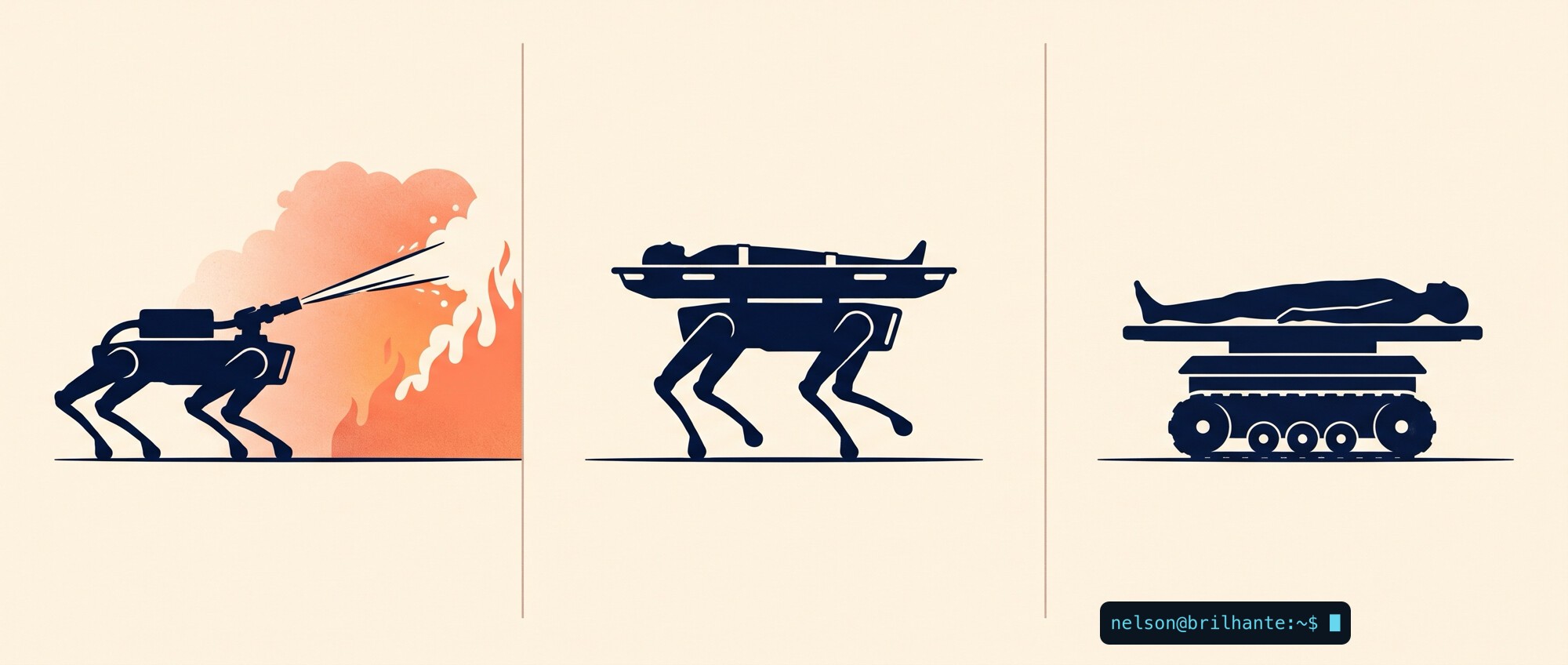
In Qingdao, China, two four-legged machines were sworn into the local fire brigade. They are Unitree's B2, from the Hangzhou maker best known for its robot dogs, rebuilt for firefighting: a cannon that throws water or foam up to 60 meters at 40 liters per second, the ability to climb 40-centimeter steps and stairs pitched at 45 degrees, and a sprinkler system whose only job is to keep the robot itself cool while everything around it burns.
There are two moments when being a firefighter can kill you: going into the fire, and pulling out whoever is trapped inside. Those are exactly the two moments where AI-driven robotics is arriving, and where it matters most.
In the fire
Unitree does not sell a robot, it sells a base with modules: a 360-degree panoramic camera, a dual-spectrum camera (it fuses thermal and optical imaging to find people through smoke), a gas sensor, a robotic arm, its own radio link in case the network drops, and an air blower for forest fires that puts them out by cutting the flame off from its fuel rather than drowning it. According to the company, the joints on the firefighting version perform 170% better than those on the standard B2, and the battery swaps out without breaking the body's seal.
Video: the Unitree B2 attacking a fire with its water cannon (Mashable).
It is not a one-off. In February 2025, the X30, made by DEEP Robotics, also of Hangzhou, was put to work by the fire brigade of Changsha, in Hunan province, in what was reported as the first time a Chinese-built quadruped joined a local rescue team. It weighs 56 kilos, works from minus 20 to plus 55 degrees, covers more than 10 kilometers on a charge, and builds a three-dimensional map of wherever it goes, which is precisely what the people deciding from outside are missing.
In the rescue
Getting an unconscious person out of a building is the part that exposes the rescuer the most, and this is where the most striking machines show up. In March 2025, in Beijing, Haishen, part of the Chinese state shipbuilding group, unveiled two medical rescue robots together with DEEP Robotics. The wheeled one carries a portable emergency station with seven functions: ventilation, monitoring, infusion, ultrasound, defibrillation, cardiopulmonary resuscitation and oxygen. The quadruped carries the stretcher with the casualty on its back and, while moving, treats them using the equipment slung on both sides.
Video: the quadruped carrying the stretcher with the casualty (CGTN).
The idea is not new. The Robocue, from the Tokyo Fire Department, has existed since 2009: a tracked machine, shaped like a small tank, that turns on the spot, scoops a motionless body off the ground and pulls it up onto itself with a conveyor belt, without any rescuer having to step in. Sixteen years later, what was a Japanese prototype is now a market with several manufacturers.
Video: the Tokyo Fire Department’s Robocue lifting a person off the ground.
What it spares the people who go in
Since 1980, 257 Portuguese firefighters have died on duty, according to the League of Portuguese Firefighters (Liga dos Bombeiros Portugueses), 21 of them between 2020 and 2025 alone. In 2025, the League counted 213 injured, and the two deaths recorded up to August that year happened in road accidents, far from any fire. This month, the fires in Vouzela and Setúbal produced dozens of injuries in a matter of days, and in Setúbal alone eight firefighters were pulled out from exhaustion.
Across the Atlantic, the picture repeats. The NFPA, the U.S. fire protection association, counted 62 on-duty deaths in 2024, and 40 of them, almost two thirds, were caused by overexertion, with 30 heart attacks.
These numbers say what the videos do not show: what injures and kills firefighters is not only the flame, it is the strain, the smoke, the weight, the exhaustion and the road. A machine that drags the hose up to the front of the fire, that withstands 55 degrees without needing breathable air, that climbs seven floors with the gear on its back and that lifts the casualty off the ground does not take the firefighter's job, it takes away the part that can kill them.
None of these machines puts out a fire on its own, nor replaces the judgment of whoever runs the operation. They do something else, they go in first, they endure what the human body cannot, and they buy time. And in firefighting and rescue, time and distance from the flame are often the difference between who comes home and who does not.
Sources: Unitree Robotics, New Atlas, Global Times, China Daily, TechCrunch, League of Portuguese Firefighters, NFPA.
#StaySafe
🙏🖖