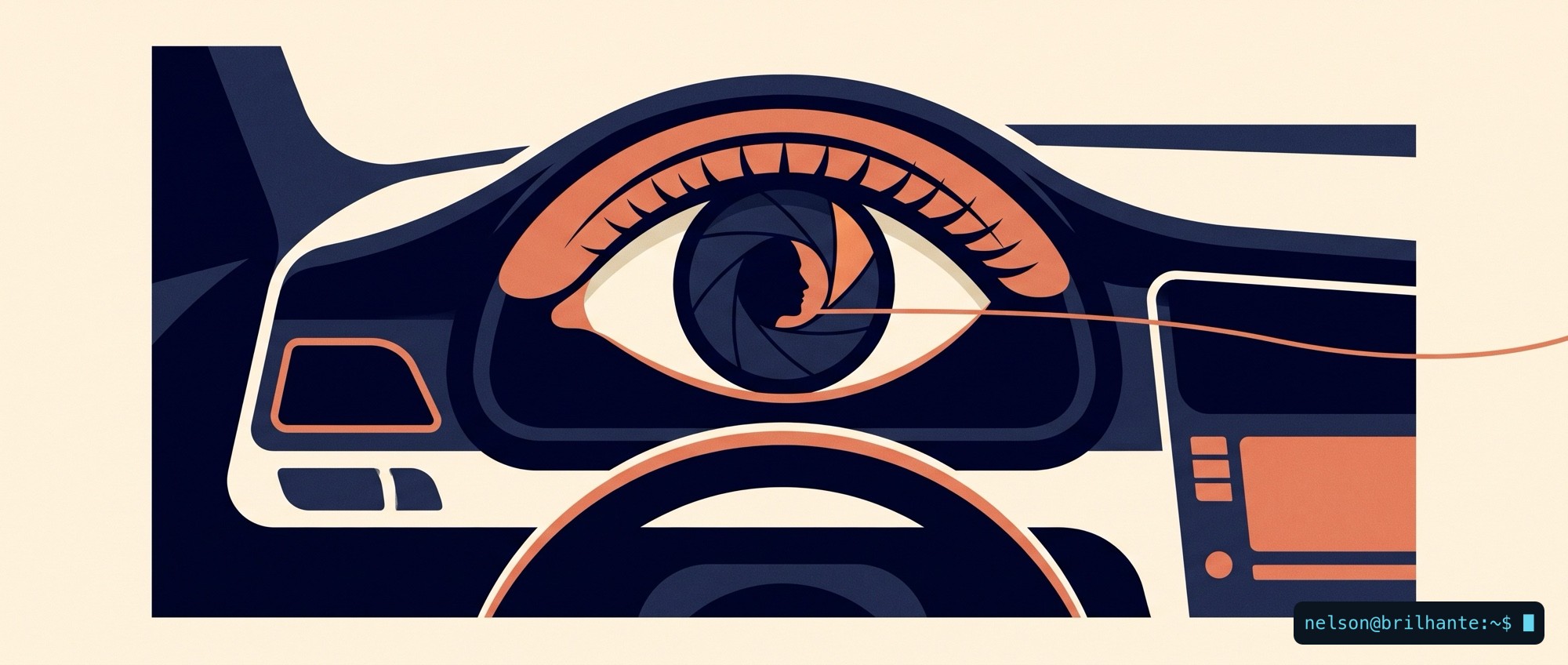
Since Monday, 7 July, every new car sold in the European Union comes with a camera pointed at the driver's face. It isn't a high-end extra or something you can turn down at the dealership. It is mandatory, on every new model, by law.
It's called ADDW, the Advanced Driver Distraction Warning system, and it's part of the EU's General Safety Regulation. A small camera, usually near the steering column or on the dashboard, tracks your head position, eye movement and gaze direction in real time. Look away from the road for more than 3.5 seconds above 50 km/h, or 6 seconds at lower speeds, and the car warns you with a visual, audible or haptic alert.
The intent is good, and the numbers back it. Driver fatigue contributes to between 10% and 25% of all road accidents in Europe, and the European Commission estimates that this package of safety technologies will prevent more than 25,000 deaths and 140,000 serious injuries by 2038, on the way to the goal of zero road deaths in Europe by 2050. No one disputes that a car that notices you are falling asleep can save your life.
The camera isn't the problem. The problem is what happens to the images it captures, and the gap between what the law promises and what anyone actually verifies.
What the law promises
On paper, Europe drew the right line. The regulation states, in so many words, that the system must work "without relying on biometric personal data of any vehicle occupants" and expressly forbids it from identifying the person. It also says it may only "record and retain data necessary for the system to function, within a closed-loop system." In plain terms, your face is analysed but not recognised, and the images are supposed to live and die inside the car, never reaching the manufacturer, the cloud, or a data broker.
Where the hole is
The words holding all of this up are "supposed to." The regulation sets the rule but creates no independent oversight to enforce it, and leaves "necessary" undefined. It's a promise no one checks. And the same camera that today only looks for signs of drowsiness is, technically, one software update away from doing much more.
This isn't paranoia, it's the track record. Consumer Reports has documented how internet-connected cars already share driving data with insurers and brokers. Brands like BMW, Ford and GM told them their systems don't send cabin images off the vehicle, and Subaru says its DriverFocus doesn't record, but practices vary from brand to brand and aren't always public. Mothers Against Drunk Driving, an organization that supports these technologies, warned that the standard "must protect driver privacy and should not make consumers vulnerable to privacy invasions or allow the collection, storage or use of their data for commercial or malicious purposes."
There is also market pressure pulling the same way. Euro NCAP, the body that awards safety stars, made driver monitoring worth up to 25 points in 2026, which pushes carmakers toward ever more capable cameras, not fewer. The camera will get better year after year. The question is whether the privacy guarantees improve at the same pace.
With any piece of evidence, the first thing you ask is who could touch it and whether that was logged. A camera pointed at your face is only as private as the weakest link that can reach the images, and right now that chain has no one watching it from the outside.
What you can demand
You can't switch off a system the law made mandatory, but you are not without options:
- Ask at the dealership, and get it in writing, where the cabin camera's data goes and whether it leaves the car.
- In the car's and the app's settings, turn off data sharing with third parties and insurers wherever the option exists.
- Before buying, check independent car-privacy reports, like Consumer Reports or Mozilla's "Privacy Not Included," which rate brand by brand.
- Treat every software update as a moment to re-confirm what the camera does and what it shares.
- Demand, as a consumer and as a citizen, independent oversight and a clear label of what the system collects. A rule no one enforces is half a rule.
The camera is here, and it isn't leaving. What's still open is whether it keeps serving your safety, or one day starts serving something else. That isn't decided in the car's engineering, it's decided by whether anyone has the nerve to watch that promise and enforce it.
Sources: Malwarebytes, EUR-Lex.
#StaySafe
🙏🖖