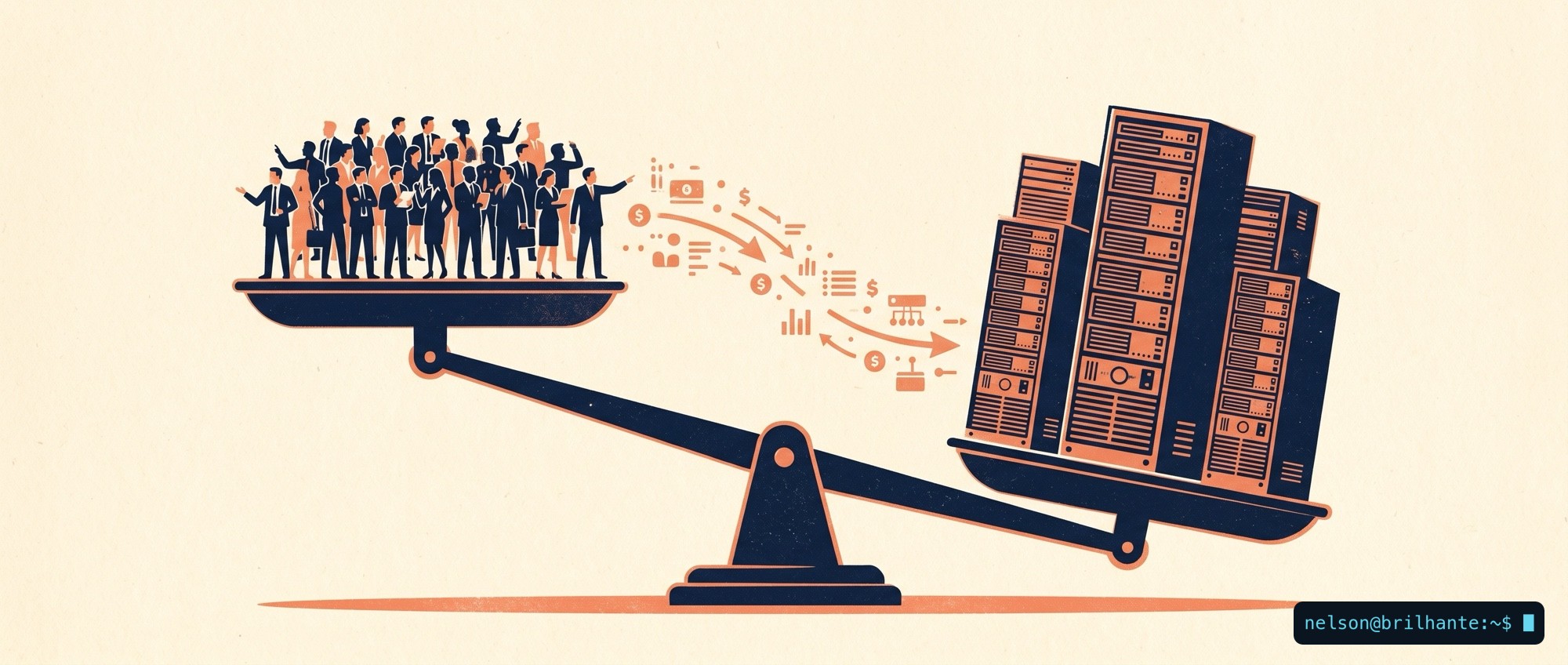
Oracle's headcount fell from roughly 162,000 to 141,000 in the space of a year, a cut of about 21,000 roles, close to 13% of the company. On its own, that would be one more round of tech layoffs. What makes this case different sits in a single sentence of the annual report Oracle filed on June 23 with the US securities regulator, the SEC: "the adoption and deployment of AI technologies across our operations have resulted, and may continue to result, in reductions to our workforce."
Companies have laid people off for centuries. What they rarely do is sign their name to the reason. In a press release, a company says whatever suits it: "optimization," "restructuring," "strategic realignment." In a 10-K, the mandatory annual report public companies file with the regulator, every word is a statement carrying legal liability, where lying is paid for in court. That is why, for years, the industry blamed the cuts on everything except the machine. A press release is narrative; a legal filing is evidence. Oracle wrote down the part that usually goes unsaid, and the abstract fear that "AI will take jobs" went from coffee-break talk to an auditable, dated, archived fact.
The money didn't vanish, it moved
There is a second number that gives the first one meaning. Over the same period, Oracle spent $1.8 billion on severance and restructuring costs, against $374 million the year before. At the same time, its spending on AI data centers jumped to $55.7 billion, up 162% on the previous year. The money didn't leave the company with the people. It moved columns in the budget: out of payroll and into the concrete and silicon that now do part of the work those people used to do. Nearly $1.9 billion to let them go, and thirty times more to build what takes their place.
And in Portugal?
Oracle is a case, not an exception. The difference is that most companies do the same thing without admitting it. And the warning doesn't stay on the other side of the Atlantic. A study by the Francisco Manuel dos Santos Foundation estimates that close to 30% of Portugal's private-sector workforce is exposed to automation and AI. For years we told ourselves this was a problem for supermarket checkouts and assembly lines. The most recent figures point the other way: the wave is reaching qualified, desk-bound work first, the work of those who analyze, write, sell and organize. The 21,000 roles Oracle cut didn't belong to factory workers. They belonged to people with degrees.
How not to become the next line in the report
There is no perfect shield, but there is firmer ground:
- In your own job, separate predictable routine from what demands judgment, context and accountability. The first part is what the machine copies best and cheapest.
- Become the one who directs the tool, not the one who competes with it. Knowing how to use these models well is, right now, a concrete advantage in the job market.
- Invest in what AI doesn't have: trusted relationships, decisions made under responsibility, and deep knowledge of a specific domain.
- Don't wait for your employer's warning. By the time the reason reaches the annual report, the decision was made long before.
The most honest sentence about the future of work wasn't spoken on a tech stage, with a rehearsed script. It was written in fine print, on the page of a legal document Oracle would rather no one read. The euphemism "efficiency" just got an invoice, and the receipt is public.
Sources: The Next Web, CNBC, Francisco Manuel dos Santos Foundation.
#StaySafe
🙏🖖