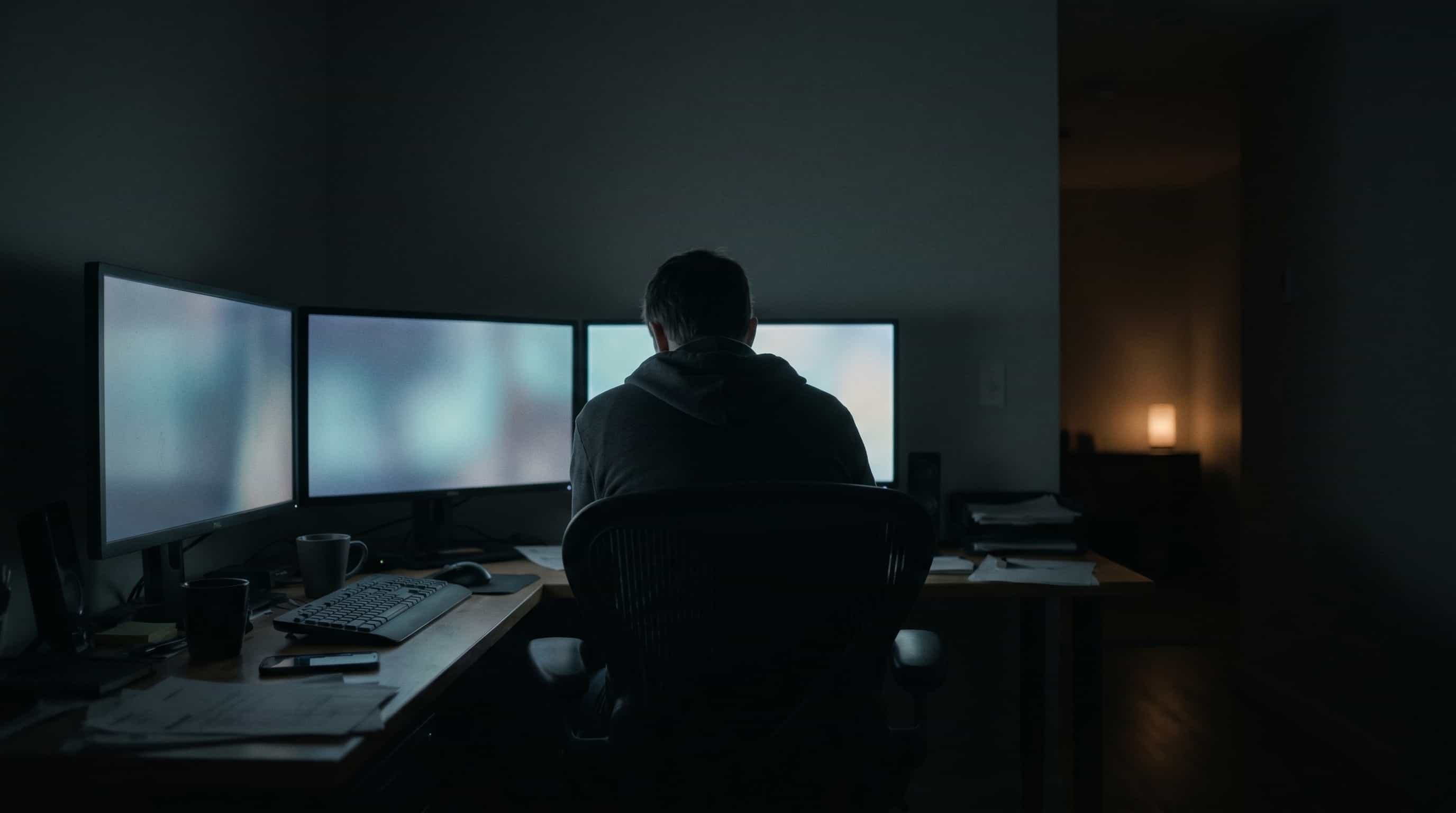
At six months, they were fine. Engaged, motivated, sure they could handle it. By the one-year mark, more than half had wrecked sleep, with recurring nightmares, intrusive thoughts, and a state of alertness that did not switch off when they left work. That is what a University of Birmingham study, published in April 2026, found after following 21 newly hired criminal intelligence analysts for 18 months. Eight of the 21, by the end of the study, were already planning to leave.
This is not weakness or a lack of grit. It is the predictable effect of prolonged exposure to the worst of what circulates online, and it has a name: secondary traumatic stress, the trauma of someone who did not live through the crime but spends their days looking at it. For years it was assumed that, being screen work, it left no mark. The evidence says otherwise.
A cost that is measured, and ignored
The research here is consistent and uncomfortable. In the first large study of investigators of crimes against children, Michael Bourke and Sarah Craun (2014) surveyed more than 600 professionals: about one in four suffered significant secondary traumatic stress. A qualitative study of examiners who deal daily with child sexual abuse material captures in its very title what the numbers do not, quoting them: "you cannot unsee the darker side of life."
What makes it worse is rarely the case itself. It is the sense of institutional abandonment. The same body of research shows that moral injury, especially the feeling of betrayal by one's own organization, predicts the worst outcomes, while feeling supported and competent protects. Much of the harm grows there: not in what is seen, but in seeing it without a safety net.
And now AI arrives
This is where the present gets harder. Generative artificial intelligence has begun producing synthetic abuse material, and the courts are already dealing with it: the United States has seen its first conviction for AI-generated child sexual abuse material. For the investigator, this means three things at once. More volume, because generating it became cheap. More realism, because the synthetic image is ever harder to tell from the real one. And a new cognitive load, that of authentication, of deciding whether what you are looking at corresponds to a real victim or a fabrication, without ever being able to lower your guard.
The same technology that multiplies the problem could, however, be turned in favor of those who fight it. Used well, AI triages, classifies, and blurs before a human needs to look, reducing exposure instead of increasing it. The question stops being technical and becomes one of priorities: we instrument the machines down to the last detail and forget to instrument the people who operate them.
Treat protection as a requirement, not a leaflet
Anyone who works with digital evidence knows the rigor demanded of the chain of custody: every file logged, every access time-stamped, nothing left to chance. We apply all that care to the bytes and almost none to those who examine them. The authors of the Birmingham study are blunt: psychological protection has to be treated "as a design constraint, not the individual employee's responsibility." Waiting for the visible crisis is arriving late.
What that means in practice, for anyone running these teams:
- Reduce exposure by design. Use AI to triage, classify, and blur material, so the human eye only comes in when it is truly indispensable.
- Cap and rotate the load. Case ceilings, role rotation, and mandatory breaks, instead of silent heroism.
- Real clinical support, not a generic helpline. Specialist care for vicarious trauma, available by default and without stigma.
- Measure before the harm shows. Regular screening for the warning signs, because at six months everything still looks fine.
There is an asymmetry we should be ashamed to keep. Machines break down and get replaced; a disk is rebuilt from a copy. The people who spend their days seeing what no one should see are not restored from a backup. Protecting those who protect us is not a wellness extra. It is part of the job.
Source: Forensic Focus. Main study: Duran & Woodhams (2026), Journal of Police and Criminal Psychology.
#StaySafe
🙏🖖