On June 9, 2026, Anthropic made Claude Fable 5 available to the public, the most capable model the company has ever opened to general users. It is the first of the so-called Mythos-class models to leave the restricted partner circle, and it ships with a set of brakes designed to limit dangerous uses.
There is a backstory. In April, Anthropic showed Claude Mythos Preview, a version it chose not to release publicly. The reason was the model's skill at cybersecurity: according to the company, Mythos Preview identified and exploited zero-day vulnerabilities in every major operating system and web browser, and found thousands of high-severity flaws. Anthropic engineers with no formal security training asked the model to hunt for remote code execution vulnerabilities overnight and woke up to a complete, working exploit. Instead of releasing it, the company started Project Glasswing, a program that gives access to the model to critical-infrastructure providers and defense teams so they can fix flaws before attackers exploit them. Hours before today's announcement, this site published a breakdown of what was fact and what was hype around Claude Mythos.
Fable 5 is, in practice, that same model with brakes. In sensitive areas, the request is no longer answered by Fable 5 and is passed to Opus 4.8, a model that is weaker in those domains. The handoff applies to three categories: cybersecurity, biology and chemistry, and attempts to extract the model's capabilities to train competitors. Anthropic says the safeguards were tuned conservatively, that users are told whenever a request is rerouted, and that they kick in for less than 5% of sessions. In those cases, according to the company, users do not pay Fable prices for the Opus 4.8 response.
The concern over biology has a concrete example. Anthropic tested Mythos 5's ability to predict how a genetic change affects the assembly of an adeno-associated virus, a component used in gene therapies but which, in the wrong hands, could help design dangerous viruses. The model, the company says, beat specialized tools using its biological reasoning alone, which illustrates the dual-use risk behind the brakes.
Alongside Fable 5, the company also launched Mythos 5, the same base model with some of the safeguards lifted. Access is restricted to Project Glasswing partners and, soon, a select group of biology researchers. Glasswing itself is being extended to roughly 150 new organizations in more than fifteen countries.
What the model can do
Anthropic presents Fable 5 as state of the art on nearly all capability tests, with a wider lead the longer and more complex the task. The example the company highlights comes from Stripe, which during testing used the model to carry out, in a single day, a codebase-wide migration of a 50-million-line Ruby codebase, work that a team would take more than two months to do by hand.
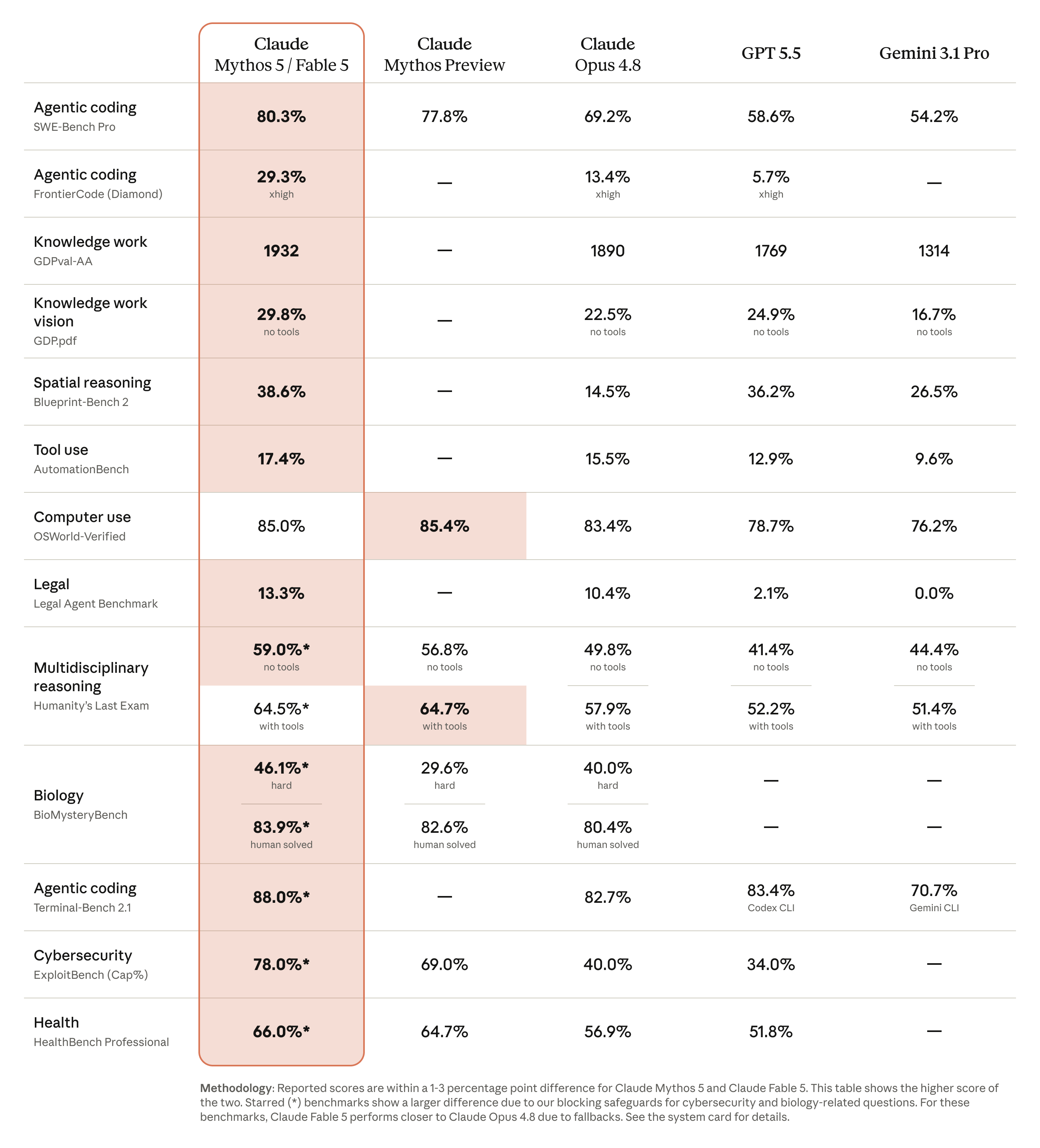
Capability comparison between Fable 5, Mythos 5, and other leading models. Image: Anthropic.
Other figures from the company: Fable 5 rebuilds a web app's source code from screenshots alone, reads precise values off scientific figures, and posted the top score on Hebbia's finance benchmark, which targets senior-level reasoning. In health, Anthropic says Mythos 5 sped up parts of the drug design process about tenfold and that nine of the 14 protein targets in one study produced strong drug candidates. On molecular-biology hypotheses, the company's scientists preferred Mythos 5's suggestions over Opus-class models in roughly 80% of cases.
Other examples show the jump in vision and autonomy. Anthropic says Fable 5 finished the game Pokémon FireRed from on-screen images alone, without the scaffolding earlier models needed, and that it built a simulation of the solar system able to predict eclipses from physical first principles. With file-based memory, the model improved its performance in the game Slay the Spire three times more than Opus 4.8.
In one of the scientific examples the company highlights, Mythos 5 carried out novel genomics research over more than a week of largely autonomous work: it assembled single-cell data for millions of cells across 138 animal species and designed and trained a machine-learning model to identify cells performing the same role in distantly related organisms. According to Anthropic, that model, a hundred times smaller, outperformed one published in the journal Science.
On the coding tests the company published, Fable 5 and Mythos 5 reach 80.3% on SWE-bench Pro, against 58.6% for OpenAI's GPT-5.5, and 29.3% on Cognition's FrontierCode Diamond, against 13.4% for Opus 4.8. Even so, the earlier Mythos Preview still leads on computer-use and multidisciplinary reasoning tasks.
Price and availability
Fable 5 and Mythos 5 cost 10 dollars per million input tokens and 50 dollars per million output tokens, less than half the price of Mythos Preview. Fable 5 is available now through the API under the identifier claude-fable-5. On subscriptions, the model is included at no extra cost on Pro, Max, Team, and Enterprise plans through June 22; on June 23 it leaves those plans and will require usage credits, until the company has the capacity to restore it as a standard part of subscriptions.
On the safety of the system itself, the company says an external bug bounty found no universal jailbreaks in over 1,000 hours of testing, although the UK AI Security Institute made progress toward one in a brief initial testing window. Anthropic also began retaining Mythos-class traffic for 30 days, even for customers who previously had zero-retention agreements, to spot new attack patterns. That data, the company says, is not used to train the models.
On the model's behavior, Anthropic says its automated alignment assessment found low levels of misaligned behavior in Mythos 5, similar to Opus 4.8.
Official Anthropic video: "Introducing Claude Fable 5".
The first reactions
The tech press and early testers split between the capability and the brake. CyberScoop summed up the launch as "Mythos on a leash." Professor Ethan Mollick, who tested the model before release, wrote that it is "a very real leap" over every model he has used, and described sessions in which Fable worked on its own for hours from a specification of a few pages. In one case it produced a complete piece of software after nine and a half hours of autonomous work, even spinning up cheaper models to gather data along the way.
Mollick called the experience both "delightful" and "unnerving": the model makes hundreds of decisions the user never sees or controls, which turns it into something close to a black box. Anthropic's own Claude Code team described a shift in method, from micromanaging tasks to checking whether the model is doing the right work.
Analyst Dan Shipper, of Every, called it an autonomous execution engine for coding, citing a working 3D game from a single prompt and a score of 91 out of 100 on a senior-level engineering test. The downside shows up in price: VentureBeat notes that, even at half the cost of Mythos Preview, Fable 5 remains the most expensive of the major models, and Mollick observed that it spends tokens very quickly. Add safeguards that are sometimes overly cautious and refuse legitimate requests. For writing and simple everyday tasks, some suggest earlier models are still more practical.
One of Anthropic's central claims also remains untested in the open: that there are no universal jailbreaks. The company says it found none in over 1,000 hours of testing, but the community that usually breaks these models' defenses shortly after launch has not yet weighed in on Fable 5.
The launch comes days after Anthropic publicly warned about the risks of increasingly autonomous frontier models. The usual tension in this industry remains: opening up capability while trying to contain what it makes possible.
Sources: Anthropic, red.anthropic.com, TechCrunch, CyberScoop, Every.
#StaySafe
🙏🖖